This is the second of the Atkinson novels featuring private investigator Jackson Brodie. It reads differently to Case Histories, the first of the series. Unlike Case Histories, which is more symmetrical in it's narrative, there are more twists and complexities in One Good Turn than one would find in the back streets of Edinburgh (where this story is set). It is however, just as satisfying if not more so, than the first novel.
But what really stands out with One Good Turn, is that Atkinson is deliberately turning the crime novel on its head and having some real fun with it. Nor is this book what is generally referred to as "cosy fiction" either. Atikinson manages to combine pith and pathos with witty humour and irony. I have read more crime fiction, of every sort, than bears thinking about, and these novels really offer something unique.
Poor ol' Jackson is at a bit of a loose end at the start of this novel. His girlfriend is taking part in a truly awful play as part of the festival. But after witnessing a road rage incident, Jackson is soon caught up in events that include murder, dodgy housing developments, brutish felons, a risque cleaning service and a paid assassin.
As with Case Histories, Atkinson creates a wonderful sense of place, this time in Edinburgh. I have been to that magical fairy land city and as Jackson remarks in the novel, it does often seem like everyone there is a tourist or a student.
Mixed in with this clever escapade, is a good exploration of how guilt and longing are so often a large part of what drives people. All of the characters, including dear Jackson, find themselves wondering what might have been over major life decisions and how those decisions have transported them to this crazy few days at the Edinburgh Festival.
Atkinson's nimble plotting left me breathless, but what I love most about these novels is that neither she nor her leading man Jackson, take themselves too seriously. Whatever emotional, or physical, mess Jackson gets himself into, he promptly dusts himself off for the next dose of life. And I for one, can't wait to read where life next takes him.
Sunday, June 12, 2011
Review: Scission by Tim Winton
Scission is an early collection of short stories by Australian author Tim Winton. "Scission" is the theme that unites all of the stories. And yes, the word had me running to the dictionary, I will freely admit. It means the tearing, or ripping apart of of something.
All of the stories highlight the moment when someone's world is split or torn apart. For the majority of the 13 stories, the scission represents an emotional awakening where there are often, but not always, negative real world consequences. It is a testamont to Winton's skill as a writer that he is able to describe this subterranean world of human emotion so vividly.
I loved these stories for many reasons. One reason is because the writing is as good as the writing in his best novels. If anything, I have found that good writers bring an even sharper edge to their short fiction, that is certainly the case with Scission. These stories hit the reader with an almighty visceral wallop,
The first story "Secrets" is about a young girl trying to come to terms with the changes in her family as a new step father takes over the power in her home. "A Blow, A Kiss" is a moving portrayal of a father and son's insecurities, but underlying love for each other, as, on the way home from a day's fishing expedition, they come across a motor bike accident victim, on a deserted road. "Neighbours" comments on multiculturalism in Australia, in a poignant tale of a newly wedded couple who, move into a house in a culturally diverse neighbourhood, and are awakened to understand that differences with their neighbours are tiny compared to what they all share. Although Winton wrote this story 25 years ago, it is a tale equally relevant, if not more needed, in the Australia of today.
All of the stories are really a preparation for the the last longer short story in the collection titled "Scission", it is about the collapse of a relationship with the worst possible outcome. This story did unnerve me because as shocking and violent as the scenario is, we hear of relationships ending in death on a regular basis in the media, even today.
Not all of Winton's writing will be to everyone's taste, at times he does appear to completely let go and his work can feel a bit disjointed and abstract. There is no spoon feeding here. But I have found that by letting go myself and just absorbing the words without worrying about the exactness of things, the whole is revealed and usually leaves me gasping. He is a fine, original writer.
All of the stories highlight the moment when someone's world is split or torn apart. For the majority of the 13 stories, the scission represents an emotional awakening where there are often, but not always, negative real world consequences. It is a testamont to Winton's skill as a writer that he is able to describe this subterranean world of human emotion so vividly.
I loved these stories for many reasons. One reason is because the writing is as good as the writing in his best novels. If anything, I have found that good writers bring an even sharper edge to their short fiction, that is certainly the case with Scission. These stories hit the reader with an almighty visceral wallop,
The first story "Secrets" is about a young girl trying to come to terms with the changes in her family as a new step father takes over the power in her home. "A Blow, A Kiss" is a moving portrayal of a father and son's insecurities, but underlying love for each other, as, on the way home from a day's fishing expedition, they come across a motor bike accident victim, on a deserted road. "Neighbours" comments on multiculturalism in Australia, in a poignant tale of a newly wedded couple who, move into a house in a culturally diverse neighbourhood, and are awakened to understand that differences with their neighbours are tiny compared to what they all share. Although Winton wrote this story 25 years ago, it is a tale equally relevant, if not more needed, in the Australia of today.
All of the stories are really a preparation for the the last longer short story in the collection titled "Scission", it is about the collapse of a relationship with the worst possible outcome. This story did unnerve me because as shocking and violent as the scenario is, we hear of relationships ending in death on a regular basis in the media, even today.
Not all of Winton's writing will be to everyone's taste, at times he does appear to completely let go and his work can feel a bit disjointed and abstract. There is no spoon feeding here. But I have found that by letting go myself and just absorbing the words without worrying about the exactness of things, the whole is revealed and usually leaves me gasping. He is a fine, original writer.
Thursday, June 2, 2011
Free Short Story App
I can't not share this Short Stories Ereader application for the iphone. It is free and easy to use and there are hundreds of old and modern stories to download. Stories are also added daily. I have found it very handy when I have a few free minutes somewhere and have neglected to bring a book with me. You can get it here
Thursday, May 26, 2011
Review: Bereft by Chris Womersley
I am very excited about this novel by Australian author Chris Womersley. It is several days since I finished it, and an echo of the story haunts me still.
Bereft opens at the completion of WWI, with Australian soldier, 26 year old Quinn Walker returning to his home town of Flint in rural New South Wales. Quinn, now a decorated soldier, has not set foot in Flint for ten years. When Quinn was 16, his 12 year old sister Sarah was brutally murdered in the small town, and Quinn was accused of the crime. The Spanish influenza epidemic is also reaping many victims in Australia at the time of Quinn's return, including his mother, who is dying. Quinn is dazed and desperate after his unspeakable experiences in the trenches in Europe and the unresolved turmoil over his sisters death. Quinn returns to Flint looking for answers.
This is an extraordinary novel that works on multiple levels. It is about trauma and its aftermath. The devastation caused by killing is explored on the individual level and also the level of the family and township. The murder of Sarah Walker devastated Quinn and his entire family. No one recovered. Womersley also powerfully depicts the impact of trench warfare on the returning soldier, in this case Quinn. His body and spirit are well and truly broken as he stumbles into town determined to try and make sense of things.
Womersley writing is faultless, direct and punchy. At just 264 pages the novel struck me as a refreshing change from the "more is more" length of much modern fiction.
The atmosphere the author creates is spine tingling. The hard, hot and remote Australian bush masterfully evokes a sense isolation and discomfort. The story is engaging and creepy. I am not in a book club, but I think Bereft would make the perfect selection for a discussion as it is not only a powerful story, but covers a range of themes that are difficult to tackle, and the ending is deliberately ambiguous. An uncertain ending will not be everyone's idea of a good time, but I found it haunting and satisfying in this case. I am thoroughly impressed by this original work, and might even have to read it again before too long.
Bereft opens at the completion of WWI, with Australian soldier, 26 year old Quinn Walker returning to his home town of Flint in rural New South Wales. Quinn, now a decorated soldier, has not set foot in Flint for ten years. When Quinn was 16, his 12 year old sister Sarah was brutally murdered in the small town, and Quinn was accused of the crime. The Spanish influenza epidemic is also reaping many victims in Australia at the time of Quinn's return, including his mother, who is dying. Quinn is dazed and desperate after his unspeakable experiences in the trenches in Europe and the unresolved turmoil over his sisters death. Quinn returns to Flint looking for answers.
This is an extraordinary novel that works on multiple levels. It is about trauma and its aftermath. The devastation caused by killing is explored on the individual level and also the level of the family and township. The murder of Sarah Walker devastated Quinn and his entire family. No one recovered. Womersley also powerfully depicts the impact of trench warfare on the returning soldier, in this case Quinn. His body and spirit are well and truly broken as he stumbles into town determined to try and make sense of things.
Womersley writing is faultless, direct and punchy. At just 264 pages the novel struck me as a refreshing change from the "more is more" length of much modern fiction.
The atmosphere the author creates is spine tingling. The hard, hot and remote Australian bush masterfully evokes a sense isolation and discomfort. The story is engaging and creepy. I am not in a book club, but I think Bereft would make the perfect selection for a discussion as it is not only a powerful story, but covers a range of themes that are difficult to tackle, and the ending is deliberately ambiguous. An uncertain ending will not be everyone's idea of a good time, but I found it haunting and satisfying in this case. I am thoroughly impressed by this original work, and might even have to read it again before too long.
Sunday, May 22, 2011
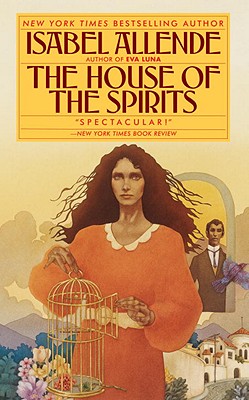
Review: The House of Spirits by Isabel Allende
The House of Spirits is the first of many popular novels written by Chilean novelist Isabel Allende, and the second I have read from her. It is epic in its conception. Set in an unnamed South American country the novel spans four generations of the Trueba and del Valle families.
The novel begins with the del Valles and the story of two beautiful sisters, Rosa and Clara. Rosa is tragically killed when mistakenly poisoned. The story then follows her fiance, the very troubled Esteban Trueba, as he builds his life around accumulating power and vengeance. He marries Rosa's sister Clara and has three children. Esteban's furious and unforgiving nature shapes the lives of all in the family.
The novel also traces social changes in this South American society as colonialism is replaced by socialism and ultimately a military coup which has disastrous consequences for the whole family.
I really enjoy Allende's language and writing style. She writes long languid sentences that turn into very long paragraphs. The sentences draw you into the drama and emotion of the family's story. She writes with a real earthiness or lust for life. The women in the novel carry most of the story and most of the readers sympathy. Clara, is the dominant force in her family, despite the fact that her husband Esteban is ferocious in his appetites and lust for power. Clara has clairvoyant and telekinetic powers. She opens the doors of their luxurious home to a host of spiritual, artistic and free thinking types. Her many charitable works and causes form a legacy that her daughter and granddaughter continue.
The novel does seem a bit long at times, but while encompassing so many lives, it remains perfectly coherent. All of the characters are distinctive and are developed believably. The ending is dramatic, very moving, and for me, more than made up for, what felt like at times, too many pages. I will continue to work my way through as many Allende novels as I can. She is an imaginative storyteller whose writing is beautiful and passionate.
The novel begins with the del Valles and the story of two beautiful sisters, Rosa and Clara. Rosa is tragically killed when mistakenly poisoned. The story then follows her fiance, the very troubled Esteban Trueba, as he builds his life around accumulating power and vengeance. He marries Rosa's sister Clara and has three children. Esteban's furious and unforgiving nature shapes the lives of all in the family.
The novel also traces social changes in this South American society as colonialism is replaced by socialism and ultimately a military coup which has disastrous consequences for the whole family.
I really enjoy Allende's language and writing style. She writes long languid sentences that turn into very long paragraphs. The sentences draw you into the drama and emotion of the family's story. She writes with a real earthiness or lust for life. The women in the novel carry most of the story and most of the readers sympathy. Clara, is the dominant force in her family, despite the fact that her husband Esteban is ferocious in his appetites and lust for power. Clara has clairvoyant and telekinetic powers. She opens the doors of their luxurious home to a host of spiritual, artistic and free thinking types. Her many charitable works and causes form a legacy that her daughter and granddaughter continue.
The novel does seem a bit long at times, but while encompassing so many lives, it remains perfectly coherent. All of the characters are distinctive and are developed believably. The ending is dramatic, very moving, and for me, more than made up for, what felt like at times, too many pages. I will continue to work my way through as many Allende novels as I can. She is an imaginative storyteller whose writing is beautiful and passionate.
Wednesday, May 18, 2011
Broadening my horizons: sketching fun and poetry.
Well May is turning out to be a curious month for me on the reading/ recreation front. I have started sketching, and no one could be more amazed than me, I have also bought a set of pastels, which I am having fun experimenting with. These new activities have seriously cut into my usual reading time.
I have not altogether abandoned novels, but feel like I am taking a little holiday and I have found myself reading poetry. I stumbled across a lovely collection of love poems by Nikki Giovanni, which I think anyone would be impressed by. Here is a little taste from one of her poems, "The Way I Feel"most time when you are around
i feel like a note
roberta flack is going to sing
I am also working my way through a Sylvia Plath collection of poetry: Sylvia Plath Poems selected by Ted Hughes. These are requiring alot more concentration.
I am not entirely sure what has gotten into me, I am busier at work, including more travelling with work, so perhaps needed a change in diversions. Also Autumn has arrived in my town, and we are currently enjoying all the beautiful colours that go with this time of year.The books about pastels that are firing my imagination, albeit with dubious and amateurish results are these: Raw Colour with Pastels by Mark Leach and Exploring Pastel with Barry Watkin. As well as being interesting and helpful, these art books look like works of art themselves.
Saturday, April 30, 2011
Meet Jackson Brodie, my latest addiction.
Case Histories by Kate Atkinson is a heck of a detective novel, the first in a series of novels featuring police inspector turned private detective, Jackson Brodie. Set in Cambridge the novel introduces three separate tragedies Brodie has been hired to investigate.
Why it works so well? Atkinson brings a different touch to the ubiquitous crime fiction genre. Brilliant, crystal clear writing helps, but she also engenders her characters with such humanity, all of them. Unlike alot of crime fiction, these characters are skillfully drawn and aroused real empathy from this reader. The focus is not on the nature of the crime, but the impact of the crime on those left behind.
The plot is also more satisfying than many crime novels I have read recently. Atkinson links three apparently unrelated "case histories" through the personal story of the detective. This works and left me with a sense of a beautiful whole by the end of the book. It is the structure of the narrative that works so well. In different ways Jackson becomes personally involved with his clients. There are few clear lines between detective and victim here, the two spill into each other, and this overlapping of stories is for me what sets the novel apart, the themes emerge alot stronger.
Jackson is very engaging. On the surface he shares many of the features of alot of his fictitious detective contemporaries: approaching middle age, a loner, broken marriage recently behind him, trying to find time to be a good father, favours a particular car, and has an easy way with the ladies. We get to know Jackson through his reactions to those around him. He is empathic, and accepting of human frailty, we learn later in the novel of the tragic circumstances in his own life that no doubt have contributed to this.
For me, Case Histories is a definite winner, and has left me wanting to read the other three Jackson Brodie novels without delay.
Why it works so well? Atkinson brings a different touch to the ubiquitous crime fiction genre. Brilliant, crystal clear writing helps, but she also engenders her characters with such humanity, all of them. Unlike alot of crime fiction, these characters are skillfully drawn and aroused real empathy from this reader. The focus is not on the nature of the crime, but the impact of the crime on those left behind.
The plot is also more satisfying than many crime novels I have read recently. Atkinson links three apparently unrelated "case histories" through the personal story of the detective. This works and left me with a sense of a beautiful whole by the end of the book. It is the structure of the narrative that works so well. In different ways Jackson becomes personally involved with his clients. There are few clear lines between detective and victim here, the two spill into each other, and this overlapping of stories is for me what sets the novel apart, the themes emerge alot stronger.
Jackson is very engaging. On the surface he shares many of the features of alot of his fictitious detective contemporaries: approaching middle age, a loner, broken marriage recently behind him, trying to find time to be a good father, favours a particular car, and has an easy way with the ladies. We get to know Jackson through his reactions to those around him. He is empathic, and accepting of human frailty, we learn later in the novel of the tragic circumstances in his own life that no doubt have contributed to this.
For me, Case Histories is a definite winner, and has left me wanting to read the other three Jackson Brodie novels without delay.
Subscribe to:
Posts (Atom)